Infrastructure Automation IT Operations Operational Toil
The Ghost in the Machine: When Milton Waddams Runs Your IT
Scott Albrecht · September 23, 2026 · 3 min read
The story is a forgotten machine quietly running the scripts, cron jobs and maintenance tasks nobody realizes the environment depends on. The hero needs to feel eerie, funny and operational at the same time—without borrowing an Office Space still or character likeness.
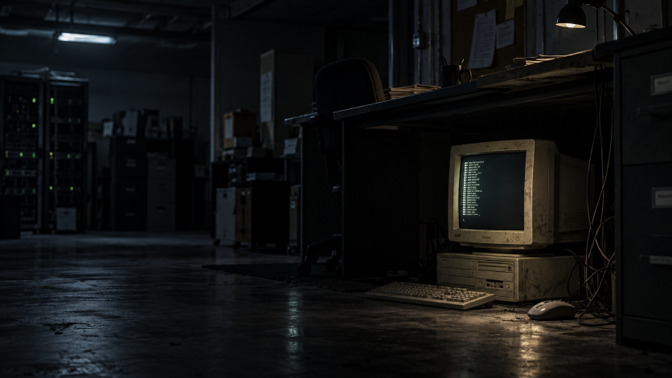
There’s something a little eerie happening over at Innotec.
It started with a soft hum...or rather, the lack of one. See, down in the basement, beneath dusty file cabinets and flickering fluorescent lights, sat a forgotten desktop computer. Old. Beige. Covered in post-it notes and sandwich crumbs from another era. It belonged to Milton, who left the company earlier this year in a huff after someone moved his desk one too many times.
Nobody really thought about Milton since he left. His farewell Slack message was, let’s just say, brief. And that old box under his desk? Everyone assumed it was just collecting dust. So when someone finally unplugged it to make room for a new mini fridge, no alarms went off. No red lights. No warnings.
And yet… that’s when the trouble began.
At first, it was small stuff. A random microservice timed out. Then a log directory overflowed and brought down a minor reporting app. No big deal. Probably a blip. But over the next few days, things got weird. Heaps were filling up for no reason. Disk space was disappearing like socks in a dryer. Old SSL certificates were expiring. And nobody could explain why.
Engineering huddled. Ops paged each other. Dashboards flickered with red. “Was this always broken?” someone asked. “Didn’t we have a cleanup job for this?” another muttered. No one knew. It was as if the company had been… haunted.
Then someone checked the basement logs. And the truth came out.
Milton’s old machine had been doing everything. Hundreds of cron jobs ran day and night — rotating logs, restarting hung processes, cleaning up temp directories, even patching edge servers on the fly. It was like a janitor, firefighter, and ghostbuster rolled into one dusty desktop. It was Milton Waddams in server form. Quiet. Overlooked. Running on stale coffee and forgotten shell scripts.
And now? Gone.
Without it, Innotec found itself unraveling — not because the systems were bad, but because nobody had any idea how they were being held together. Milton never documented it. No Git repo. No hand-off. Just a ghost in the machine, bailing water 24/7 while everyone assumed the boat wasn’t leaking.
This kind of thing happens more than we like to admit.
Behind every sleek dashboard and polished deployment pipeline, there’s usually a Milton. Maybe not a person — maybe a script, a cron job, a duct-taped Jenkins build, or some YAML buried in an ancient EC2 instance. And when it goes away, suddenly you realize how much you relied on something you didn’t even know was there.
So what can we learn from Innotec?
For starters, visibility matters. Not just into what’s running — but why it’s running, and who owns it. Second, automation shouldn’t live in shadows. It should be modeled, managed, and shared — not scattered across desktops like digital breadcrumbs. And most of all, if your business depends on invisible glue, it’s time to stop crossing your fingers and start building systems that make the glue visible, usable, and secure.
That’s where OpsZ comes in.
We built OpsZ for the other 90% of IT — the messy middle where real work gets done. It’s a platform that helps you bring your scripts, automations, and workflows out of the basement and into the light. With OpsZ, you can model what’s happening across your systems, plug in your existing tools, and run workflows across any environment — public cloud, private datacenter, or that ancient server under someone’s desk.
It’s not about replacing Milton. It’s about making sure nobody has to be Milton ever again.
Because if you’re lucky, the ghost in your machine just wants his stapler back. But if you’re not… well, you might be one unplug away from disaster.