IT Operations AI Operations / AIOps Enterprise IT
Flying Blind in a Sea of Data
Scott Albrecht · September 23, 2026 · 4 min read
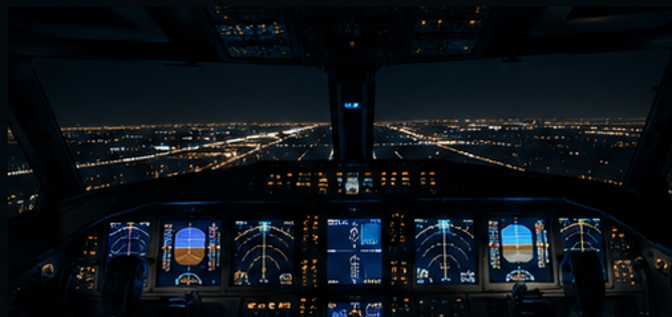
Night cockpit with rich instrument density and darkness beyond the glass. The visual should feel informationally saturated but still uncertain.
Story Time…
The flight should have been easy. It was a clear day over Florida, the skies were smooth, and the landing ahead was supposed to be completely routine. The pilots were relaxed, monitoring the instruments while the autopilot handled most of the descent.
Everything looked normal…until it didn’t.
Between 3,000 and 2,500 feet, the nose of the plane began to drop significantly faster than expected. The pilot flying made an adjustment, believing he was in vertical speed mode and commanding a gentle descent. But he wasn’t. Without clear notice, the aircraft had switched to open descent mode, chasing a different altitude the crew hadn’t intended to prioritize. Every input made things worse. The plane accelerated, altitude vanished, and alarms started to scream through the cockpit.
By the time they realized the mismatch, the aircraft was seconds from catastrophe. They recovered, but just barely. They were able to save the flight, and hundreds of lives, because they recognized they were in the wrong mode. They got lucky.
The real danger that day wasn’t weather, or mechanical failure, or even a lack of information. It was purely mode confusion — the deadly mismatch between what the pilots think is happening versus what is actually happening.
Mode confusion is a flight term, but it’s not unique to aviation.
Every day in IT operations; surrounded by dashboards, switching between consoles, and buried under endless streams of information, operators face the same invisible risk. Not because they lack data, but because that data is fragmented, disconnected, delayed, or out of context. Without clear guidance, even the best engineers can make critical mistakes. And just like in a cockpit, by the time you realize you’re working under the wrong assumptions, it could already be too late.
It’s bad enough when mode confusion happens inside a single system. But in IT operations, we often make it even worse by forcing operators to jump constantly between disconnected tools, screens, and sources of truth.
This is what’s known as swivel chair operations.
Imagine an engineer bouncing between a monitoring dashboard, a ticketing system, a Slack channel, a cloud console, and a security alert feed, trying to piece together a complete picture from fragments. Each system shows part of the truth. Each system has its own context, its own "mode." And every time the operator shifts between them, there’s a cognitive tax a chance for context to slip and assumptions to drift. So even when all the information technically exists, it’s generally scattered, delayed, and disconnected making it far easier to act on the wrong assumptions at exactly the wrong time.
Swivel chair operations don’t just slow teams down. They amplify mode confusion, and in high-pressure moments, that’s exactly how smart, capable people can end up making the worst possible decisions.
The danger isn’t just theoretical. When mode confusion and swivel chair operations combine, they create exactly the kind of mistakes that destroy reputations. Pushing the wrong patch to production. Making a firewall change that accidentally cuts off a region. Misdiagnosing a security event because critical context was buried in a separate system.
We’ve seen the consequences play out publicly, even in recent months. The CrowdStrike incident in 2024, which caused mass Windows outages around the world, stemmed from a rushed, faulty update. While not officially framed as mode confusion, it shares the same DNA: fragmented communication, disconnected systems, and operational assumptions that turned a routine update into a global crisis.
Likewise, major security breaches from accidental misconfigurations in cloud services to failed disaster recovery cutovers often aren't caused by incompetence. They’re caused by good people making urgent decisions based on incomplete, scattered, or misleading information.
When systems don't provide the right context at the right time, it's not just a technical failure it's a brand failure. Customers don't see "mode confusion" or "swivel chair operations." They just see broken trust.
That’s exactly why we’re building OpsZ to fix the broken operations workflows that allow mode confusion and swivel chair operations to thrive. OpsZ doesn't just collect information; it organizes it around the operational context. Instead of forcing engineers to hunt across disconnected systems, OpsZ surfaces what matters based on the actual mode of operation, whether that’s diagnosis, escalation, remediation, or recovery. At any moment, OpsZ aligns the right workflows, the right systems, and the right data, all connected to the operator’s current goal. No guessing what’s active. No chasing missing pieces across dashboards. No mental gymnastics is required to keep the entire system state in mind during high-pressure moments.
In OpsZ , if you’re diagnosing, you get guided paths and causal maps not endless log streams. If you’re remediating, you get just-in-time actions tied directly to the impacted systems. If you’re escalating, you get clean handoffs with live state snapshots instead of relying on fragmented tribal knowledge. By making operational modes explicit, visible, and contextually supported, OpsZ reduces the chance of small mistakes snowballing into major incidents. It gives engineers the clarity and confidence to act faster, smarter, and with far less risk of stepping into the wrong workflow at the wrong time.
Because in modern operations, clarity isn’t a luxury it’s a survival skill
Visit our site www.opsz.ai and follow us OpsZ where you get Actionable Intelligence.